





What is the Theory of the Four Humours?
The theory of the four humours (also known as humoralism) holds that four bodily fluids determine physical and mental balance. These fluids are:
- Blood
- Phlegm
- Yellow bile
- Black bile
In the classical approach, an imbalance of these humours affects wellbeing and temperament. This idea served for centuries as the foundation for nutritional traditions and ways of life.

Origins in Hippocrates and Antiquity
As far back as ancient Greece, Hippocrates described these four bodily fluids as the basis of physical and mental characteristics. A person was considered to be in balance when all humours worked together harmoniously – an early concept of homeostasis. In a historical context, we can draw parallels to ancient dietary and lifestyle practices, as they were later further developed in the European Middle Ages.
Character Types and Temperaments
From the theory of the four humours developed the notion of the four temperaments or four character types, each associated with a dominant bodily fluid:
- Sanguine: dominated by blood – lively, sociable
- Phlegmatic: shaped by phlegm – calm, deliberate
- Choleric: dominated by yellow bile – energetic, quick to anger
- Melancholic: dominated by black bile – thoughtful, sensitive
Even though these associations are no longer considered scientific today, they offer a fascinating insight into historical ways of thinking and the study of temperament.
The Four Humours & Nutrition
Nutrition played a central role in the theory of the four humours: foods and drinks were assessed according to whether they had a "warming" or "cooling", "moist" or "dry" effect – aspects that can also be found in traditional nutritional teachings.
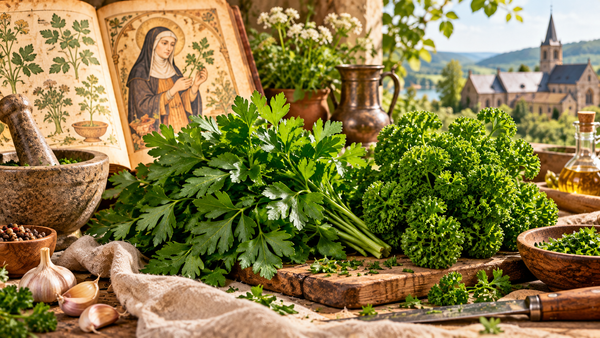
In Hildegard's nutritional teachings, the focus is likewise on making conscious food choices. She too adopted the idea of humoral balance and combined it with her own traditions regarding herbs and foods.
Practical Relevance Today
Even though the theory of the four humours is not part of modern science, it can help us to consciously reflect on diet and lifestyle. Those who eat according to Hildegard von Bingen, for example, consciously incorporate plant-based foods and balanced meals – similar to the principle of choosing foods according to their qualities.
A simple example: warming foods can be perceived as soothing on cool days, while "cooling" foods feel more refreshing on hot days. This idea is related to the historical classification of the four humours according to qualities.
Conclusion
The theory of the four humours is a fascinating historical approach that shaped thinking about human beings for centuries, until modern science took new directions. Nevertheless, the underlying idea – mindfulness towards foods and their significance for our wellbeing – lives on in many nutritional traditions.
If you are interested in conscious nutrition and Hildegard's teachings, it is worth taking a look at traditions such as the fasting soup according to Hildegard von Bingen or our range based on Hildegard's teachings.