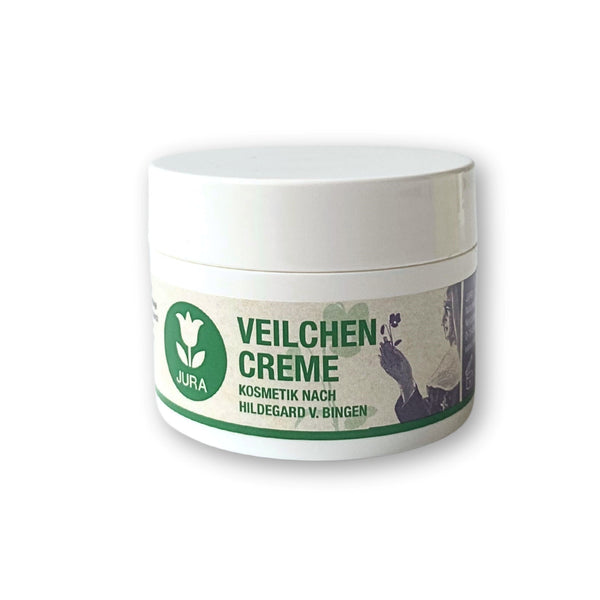




Hildegard von Bingen – who doesn't know her name? Yet behind this well-known name stands a woman who surpassed her era in many respects. She was born in 1098 in a small village called Bermersheim, which today belongs to Rhineland-Palatinate. Even as a little girl, she showed an extraordinary sensitivity to the world around her – something that would accompany her throughout her life.
At just eight years old, Hildegard entered the monastery of Disibodenberg, where she received her education. But she was more than a devout nun – she was a woman who never confined herself merely to describing articles of faith, but who also viewed the world through the eyes of an explorer. Her spiritual visions began early and guided her on a journey that left her contemporaries in awe. She experienced things that many considered inexplicable, and she brought these profound experiences into her teachings.
But Hildegard was not only a mystic. She was also a woman with an incredibly broad horizon. She was interested in the powers of nature, in herbs and plants, which she understood as true gifts of the earth. Her knowledge of the plant world was revolutionary at the time and remains of great importance today.
Hildegard lived in an era when most women had barely any voice. Yet she fought to be heard – and she did so in her own deeply profound way. What she still teaches us today is not only knowledge of the power of nature, but also the courage to follow one's own path, even when it initially seems uncertain.
So that is a first glimpse at her life. But what makes her visions and her spiritual journey so special? We'll take a closer look at that in the next section.
Hildegard's Spiritual Visions and Their Significance
So, imagine you are a young girl in the Middle Ages and suddenly you see things that others cannot see. You hear voices telling you what to do – and not just anything, but truly great, profound things. That is exactly what happened to Hildegard von Bingen. And trust me, it must have seemed a little strange. But she didn't think, "Oh, I must be going mad" – instead, she felt that she was being allowed to experience something very special.
From an early age, Hildegard had these visions, and she understood them as divine messages. She was not simply a nun who got through the day with prayers and meditations – no, she had a deeper connection to the world and to the divine. And this was not just a fleeting "oh, I feel a bit spiritual" moment, but something that truly fulfilled her and shaped her entire life. She felt directly guided by God. And that brings us right to the point: she believed these visions had a deeper meaning, not only for herself, but also for the people around her.
And, honestly, she was quite clever. Hildegard did not only see angels or divine apparitions – in her visions, she also understood how everything is interconnected: nature, body, soul, and spirit. For her, wellbeing was not merely a question of individual measures. It was much more a holistic approach. A person is part of nature, and when the body is well, the soul should also be in balance – and vice versa. Sounds somehow familiar, doesn't it? Almost as if this idea is playing an increasingly important role in the modern world today.
But what I find truly fascinating about her is that she never dismissed all these deep spiritual experiences as "oh, I'm just special." She knew that what she was experiencing was a message that mattered not only to herself, but to the entire world. She wanted to share her knowledge and help people live more consciously – on every level. And that is probably also one of the reasons why her work and her teachings continue to leave a lasting impression today.
In the next section, we'll look at how she translated this knowledge from her visions into practice – and why it still has so much to say to us today.
Hildegard von Bingen as an Herbalist
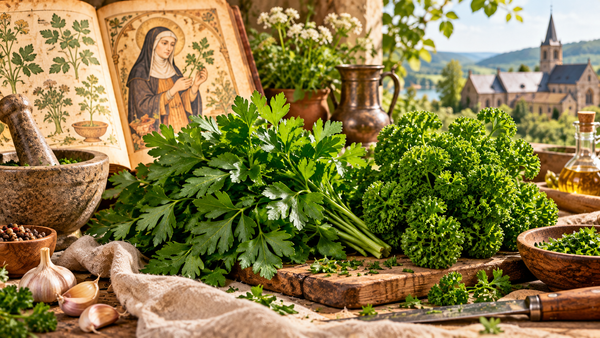
Okay, let's talk about one of the most fascinating parts of Hildegard's life – her passion for herbs and the power of nature. You have to picture it like this: Hildegard was not simply a nun meditating in a quiet monastery cell (though, admittedly, that was part of her life too). No, she had a genuine drive to know everything that grows. She knew plants and herbs like almost no one else of her time and knew exactly, according to her teachings, what they could be used for.
What was wonderful about Hildegard was that she truly saw nature as a living organism. She had this remarkable sense that everything is interconnected. The body, the soul, the spirit, and the plants – all exist in a great, harmonious exchange. If you were not physically well, she often linked it to an imbalance within yourself. And that is where her visions came into play: she was convinced that divine wisdom had shown her how things are connected.
She was also genuinely creative. You can imagine her as a mix between a medieval apothecary and a modern herbalist. She developed an entire collection of formulas, which she recorded in her writings. And the best part? Many of her preparations were based on natural ingredients that are still used in herbalism today. Her knowledge of plants and their properties was, even back then, quite ahead of its time!
But Hildegard was not merely a typical herb woman. She was deeply involved in the spiritual and practical application of her teachings. Her methods were based not only on plants, but also on the philosophy that a person must be viewed as a whole – body, mind, and soul. The combination of these elements was her approach. And when you look at the growing popularity of holistic approaches today, you realise that Hildegard simply struck a chord. Her holistic view of life is truly on-trend again today.
In the next section, we'll look at how she documented all this knowledge in her famous works and why these writings still have so much to offer us today. Stay tuned!

Matching this article

Hildegard's Legacy: A Look at Her Works
Now it gets exciting, because here comes the truly remarkable part: Hildegard von Bingen was not only an herbalist, but also an incredibly prolific writer and thinker. Her works are a genuine legacy to this day – and I cannot begin to tell you how impressive it is that, at a time when most women barely had a voice, she accomplished so much.
Best known are probably her writings on herbs and nature, but she also set down her mystical visions in writing. She was tremendously diligent and left behind a whole series of books addressing both spiritual and practical themes. Her "Physica," for example, a comprehensive work on plants and their applications, is still a widely regarded standard reference today. And then there is "Causae et Curae", in which she explores the interplay between body, mind, and soul – here too she goes far beyond mere facts and always considers the person in the context of their inner world.
But it is not only knowledge of plants that is contained in her works. Hildegard was also an enthusiastic musician and composer. Yes, you heard that right – she composed an entire series of liturgical chants and hymns. Her music is today an incredible treasure, offering us a fascinating insight into the spirituality and culture of the Middle Ages. Anyone who listens to her music will notice how deep and moving her compositions are. The melodies have something very elevating and at the same time soothing – almost like a prayer.
What I particularly appreciate about Hildegard's works is how timeless they seem. She viewed life as a whole – not merely as an isolated interplay of body and mind. She always saw the connection between all things, and that is precisely what makes her writings so valuable today. When you read her books, you quickly notice that her wisdom is still incredibly relevant in the modern age.
In the next section, we'll take a look at what we can learn from Hildegard's life and work for our own lives. Because, honestly, her messages are still very much like a recipe for a conscious, balanced life.
Conclusion: Hildegard von Bingen – What We Can Learn from Her
Okay, let's be really honest now: what can we actually learn from a woman who lived over 800 years ago? Quite a lot, as it turns out. When you think about it, Hildegard von Bingen was not simply a nun or a "wise woman from the Middle Ages" – she had this genuinely remarkable outlook on the world. She already knew back then that wellbeing is about so much more than just the body. She truly understood the connection between body, mind, and soul – and that is an approach that is gaining ever more significance today.
What I truly admire about her is that she did not simply base her view of life on the prevailing ideas of her time. She knew that it is not only about plants and formulas, but that inner balance is equally important. And that is somehow completely timeless. Which of us doesn't sometimes feel "out of balance"? Hildegard would probably advise us not to rely solely on external things, but to include our thoughts and feelings as well.
Then there is the matter of nature – a theme she handled back then like a true natural talent. She knew that plants can do far more than simply look beautiful. For her, they were the keys to a more conscious life, and her holistic perspective showed us how deeply connected we are to nature. Today, in times of mindful nutrition and herbalism, that almost sounds normal. But hey, she was definitely far ahead of her time.
What touches me most about Hildegard is how she combined her deep spirituality with her practical knowledge. She was never simply "the wise woman in the monastery," but one who truly stood in the world with both feet firmly on the ground. Perhaps there is an important message in that for us too: it is not only about what we do or what we eat, but also about how we see ourselves and how we connect with what surrounds us.
So, the next time you are working on your own wellbeing (and let's be honest, who isn't?), perhaps think of Hildegard. She has truly left us a little piece of wisdom that is just as relevant today as it was back then. She reminds us that life is one great whole – a bit like a puzzle where every piece matters. And who knows, perhaps you will find in her writings a thought or two that enriches your life just a little. Discover our most popular products based on Hildegard's teachings and let yourself be inspired.