
What exactly is Bertram?
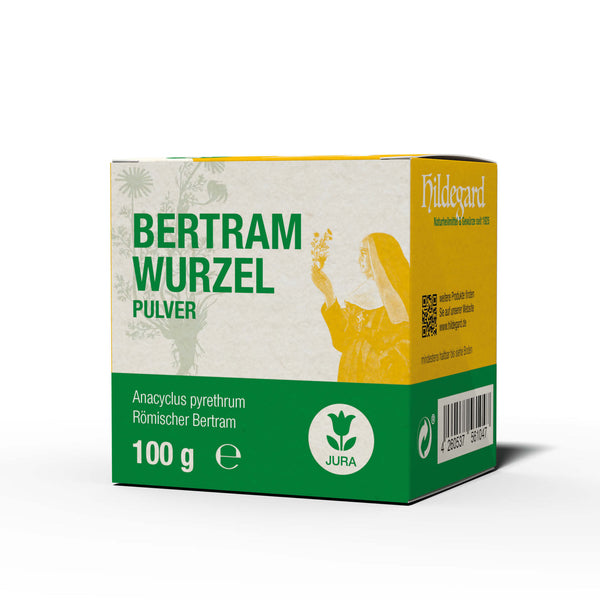
Bertram – botanically known as Anacyclus pyrethrum – is a plant from the Mediterranean region that had long been almost forgotten in our part of the world. It belongs to the daisy family and is related to chamomile or arnica.
The root of the plant contains valuable active compounds such as essential oils and flavonoids, which give it its earthy flavour – making it well tolerated even by sensitive individuals.
In herbalism, the dried, finely ground powder is most commonly used. Today, Bertram is experiencing a quiet rediscovery, particularly in the context of the so-called Hildegard diet.

The role of Bertram in Hildegard's teachings
In her writings, Hildegard von Bingen praised Bertram in the highest terms. For her, it was one of the most important spices of all. In her own words: "Bertram warms the brain and the heart, cleanses the stomach and drives the bad blood out of a person."
These statements may sound unusual to modern ears, but they fit well within the worldview of the time. Hildegard frequently spoke of "phlegms" and "humours" in the body, whose balance determined a person's wellbeing. In this context, Bertram had the task of counteracting "heaviness" and "cold conditions" – as described figuratively in Hildegard's teachings.
From a modern perspective, one can say: Bertram is a fascinating spice with a long tradition, to which Hildegard attributed special significance in her teachings.
Matching this article
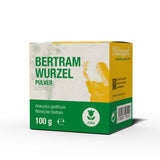
What makes Bertram so special?
Modern studies on Bertram are still scarce, but the wealth of handed-down experiential knowledge is extensive. Some of the properties attributed to Bertram include:
-
Rich in active compounds: The root contains bitter compounds, flavonoids and essential oils that give it its characteristic flavour.
-
Warming character: Similar to ginger, Bertram has a warming quality that makes it particularly popular during the cooler months of the year.
-
Versatile in use: In Hildegard's teachings, Bertram was described as one of the most versatile spices.
-
Long tradition: In traditional herbalism, Bertram is among the most frequently mentioned plants.
Important: Bertram is not a substitute for medical treatment – but it is an interesting companion within the framework of a mindful diet according to Hildegard's teachings.
Practical application: Bertram in everyday life
Anyone who looks more closely at Hildegard's dietary principles will quickly come across the tradition of using Bertram daily in small amounts. Her teachings convey, in essence: "He who eats Bertram every day will be spared from many illnesses."
Bertram is traditionally used finely ground as a spice sprinkled over food – for example:
-
over vegetable dishes, soups or stews
-
on buttered bread or with cream cheese
-
stirred into warm drinks such as grain coffee
-
combined with other spices according to Hildegard such as galangal or wild thyme
Bertram tablets or tabs based on Hildegard's recipes are also available today – but what remains important is this: the focus is on daily, moderate use. It is not about large quantities, but about the mindful integration into everyday life.
A look into history – and into the future?
The fact that Hildegard von Bingen attributed such a central role to Bertram is remarkable – especially since it plays virtually no role in our Western cuisine today. In times when we are once again paying greater attention to mindful eating and traditional herbalism, interest in such "forgotten" herbs and spices is growing.
Bertram stands for a return to simplicity, naturalness and a close connection between nutrition and mindfulness. And perhaps that is precisely its true value: not as a superfood or trend product, but as a quiet companion to a conscious way of life.

Conclusion: Bertram – a flavourful companion with a long tradition
In the world of Hildegard von Bingen, every spice had a meaning, and hardly any was mentioned as regularly as Bertram. Its warming quality, its versatility in the kitchen and its centuries-old tradition make it a little treasure for all those who are interested in Hildegard's teachings.
Bertram reminds us that it is not always the striking remedies that fascinate – but often the quiet, unassuming ones. Those who are curious about traditional herbs and Hildegard's holistic view of life will discover in Bertram a new favourite spice – not as a miracle cure, but as a sign of mindfulness and inner balance. Discover our range according to Hildegard's teachings.