This page explains which species exist, how to identify true lavender, when to harvest and how the flowers can be used in cooking.
True Lavender and Its Relatives
For use as a spice or infusion, practically only one species comes into consideration: true lavender. The others are ornamental plants or raw materials for the fragrance industry.
| Species | Botanical name | Fragrance and flavour | Use |
|---|---|---|---|
| True lavender | Lavandula angustifolia | Fine, floral, slightly sweet | Cooking, infusions, scent sachets |
| Spike lavender | Lavandula latifolia | Distinctly camphor-like, pungent | Fragrance extraction |
| Lavandin | Lavandula × intermedia | Strong, camphor-dominant | Oil extraction, scent sachets |
| French lavender | Lavandula stoechas | Resinous, bitter | Ornamental plant |
Lavandin is a cross between true lavender and spike lavender. It grows more vigorously and yields more oil — most of what stands on the famous violet fields of France is lavandin, not true lavender.
How to Identify True Lavender
- Height. True lavender stays compact, usually 30 to 60 cm. Lavandin grows noticeably taller and wider.
- Flower spike. True lavender has a single spike on each stem. Lavandin often produces two additional lateral spikes.
- Fragrance. The most reliable characteristic. True lavender smells soft and floral; lavandin and spike lavender smell distinctly camphor-like — a scent reminiscent of cold-relief balm.
- French lavender is unmistakable: it has conspicuous, ear-like bracts at the top.
When buying dried goods, it is worth checking the botanical name. If it says Lavandula angustifolia, it is true lavender — as is the case with the organic lavender flowers.
Matching this article
Flowering Season and Harvest
True lavender blooms in Central Europe from June to August, and correspondingly later at higher altitudes. Those who wish to use the flowers should harvest them not at full bloom but a little earlier.
The right moment has arrived when the lower flowers on the spike have opened and the upper ones are still closed buds. At this point the essential oil content is at its highest, and the flowers are less likely to fall off during drying.
- Harvest in the morning, after the dew has dried — roughly between nine and eleven o'clock.
- In dry weather. After rainy days, wait two to three days.
- With sharp scissors, cutting whole stems rather than picking off individual flowers.
Drying and Storing
Lavender is one of the most straightforward herbs to dry. Tie small bundles, hang them upside down in a dark, airy place and wait one to two weeks. Light bleaches the colour — so keep them out of direct sunlight.
The flowers are ready when they can be easily stripped from the spike and the stems snap cleanly. After that, store them airtight and in the dark; whole flowers retain their aroma considerably longer than crushed ones.
This is covered in detail in the article Drying herbs: methods, timings and proper storage.
Lavender in the Kitchen
In southern French cuisine, lavender is a spice like any other — used sparingly, because otherwise it overpowers everything. A pinch goes further than you might expect.
- In herb blends. Classic alongside thyme, rosemary, savory and oregano.
- In baked goods. Shortbread, pound cake, madeleines. Finely crush the flowers and mix them into the flour.
- As lavender sugar. A tablespoon of dried flowers in a jar of sugar, left to infuse for two weeks, then sieved.
- In syrup. Bring sugar and water to the boil, add the flowers, leave to cool, then strain.
- With lamb and poultry. Very sparingly, usually in combination with rosemary.
On quantity: Lavender can quickly turn soapy. Start with a knife-tip's worth for four portions and only increase the amount the second time round.
Lavender Flowers as an Infusion
For one cup, pour hot — no longer boiling — water over about one teaspoon of dried flowers and leave to steep, covered, for five to eight minutes. The lid is not a minor detail — without it the essential oils escape with the steam.
The infusion tastes strongly floral and many people find it unfamiliar. Those who prefer a milder flavour can blend lavender with other herbs — hyssop, Bachminze or fennel herb are common partners.
Lavender in the Monastic Tradition
Lavender is among the plants described in the herbal books of the Middle Ages, including in Hildegard's Physica. It came to Central Europe from the Mediterranean region via monasteries — in the open ground north of the Alps it was long something of a rarity, as it requires dry, calcareous soil and plenty of sunshine.
As with all texts of this period, a note of context is appropriate: the Physica is a document from the 12th century and follows an understanding of nature that is not comparable to today's. It records how the plant was used at that time.
More about the plants of this tradition can be found in the overview The most important spices according to Hildegard von Bingen and in the article Herbs – The comprehensive overview for garden, kitchen and tradition.
Frequently Asked Questions
Which lavender is suitable for cooking?
Exclusively true lavender, Lavandula angustifolia. Lavandin and spike lavender taste camphor-like to soapy due to their high camphor content.
When does lavender bloom?
In Central Europe from June to August. Harvesting takes place just before full bloom, when the lower flowers are open and the upper ones are still closed.
What is the difference between lavender and lavandin?
Lavandin is a cross between true lavender and spike lavender. It grows larger, yields more oil and has a distinctly more camphor-like fragrance. It is not suitable for cooking.
How long do dried lavender flowers keep?
Stored airtight and in the dark, they retain their full aroma for about one year. After that they remain usable but lose some of their fragrance.
How much lavender should you use in cooking?
Very little. A knife-tip of crushed flowers for four portions is a good starting point.
Can lavender flowers be mixed with other herbs?
Yes, that is in fact the usual approach. Classically with thyme, rosemary and savory; for infusions with milder herbs.
Why does my lavender taste soapy?
Two causes are possible: too much of it, or it is not true lavender. Check the botanical name on the packaging.
More from Our Range
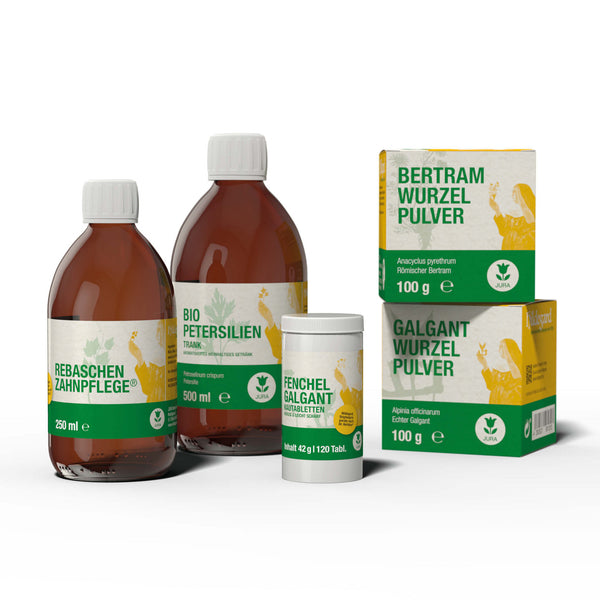
The organic lavender flowers come from certified organic cultivation (DE-ÖKO-006). Further dried herbs can be found in the category Spices according to Hildegard — including Quendel, yarrow herb and organic oregano.
Portraits of individual plants can also be found on the pages Bachminze and Quendel nach Hildegard.