
Celery is one of those plants that gets lost in the refrigerated aisle. A gnarled, earthy root vegetable that many people don't know what to do with – until it ends up in a soup, in the oven, or in an old monastery kitchen. In recent years, celery tablets have been appearing more and more frequently on the shelf next to it. Small capsules, pressed tablets, powder in tins. Celery – as a pill. Anyone searching for them quickly finds grand promises. Anyone who looks honestly finds a herb with a long history and a relatively simple question: Do you need the tablet, or will the root do?
What are celery tablets, exactly?
Before we discuss whether they make sense or not, a brief factual overview. Celery preparations are almost always dietary supplements – not medicines. They come in several forms:
| Form | What's inside |
|---|---|
| Celery powder capsules | Dried, ground celery root or seeds |
| Celery extract tablets | Concentrate of individual active ingredients |
| Celery juice powder | Dried juice, often pressed |
| Combination products | Celery combined with other plants |
Legally, they are foodstuffs – which means they may not carry specific health-related claims unless these have been reviewed and approved. For celery, the EFSA has not yet approved any such health claims. Everything claimed in advertising copy about blood pressure, blood sugar, cholesterol, potency, or drainage is either tradition, marketing, or unlawful – sometimes all at once.
Why people search for celery tablets
Anyone who looks at the search queries on this topic sees a few recurring motives: blood pressure, drainage, potency, cholesterol, gout. Celery has a fairly prominent reputation in folk medicine – for centuries, across various cultures. The question is only: does a tablet replace what has traditionally been attributed to the root? And is the reputation medically proven, or a narrative from old herbals?
Honest answer: both. Folk medicine has used celery extensively and gladly. Modern research has examined some of its constituents, but no reliable, approval-ready claims have emerged. That's why celery supplement packaging usually says very little that is concrete – and what is said quickly drifts into grey areas.
Matching this article
Celery in the monastery tradition
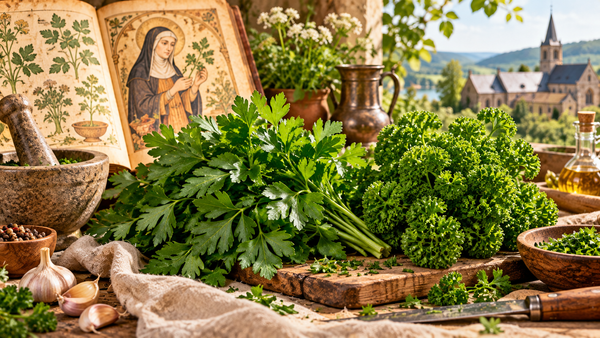
More interesting than the modern capsule is celery in its classical use. Celeriac and stalk celery have both been known in Europe since antiquity. Among the Greeks, it was sacred to the plant of the dead, while simultaneously being a symbol of honor – winners of certain competitions received celery wreaths instead of laurel. Among the Romans, it reliably ended up in soups and stews.
In medieval monastery gardens, celery was a natural resident. Charlemagne listed it in his Capitulare de villis as one of the plants to be grown in imperial gardens. Hildegard von Bingen mentions celery in her Physica (calling it eppich) – though interestingly, her assessment is mixed. She describes it as a vigorous plant but cautions against consuming it in large quantities. A very Hildegard-typical trait: even with useful plants, moderation applies.
For more on Hildegard's attitude toward cooking, see our article on nutrition according to Hildegard von Bingen.
Fresh celery root versus tablet
Perhaps the most honest observation: anyone seeking the benefits of celery will find them most reliably in the root itself. A celery root for one or two euros delivers more secondary plant compounds, more dietary fiber, more water, and a more complete flavor profile than any tablet ever could – quite apart from the fact that the root simply tastes wonderful in a stew.
What the tablet theoretically offers is convenience. Someone who doesn't eat celery in everyday life but still wants to incorporate some element of it into their diet is more likely to reach for a capsule. Is that the wisest approach? From the perspective of the monastery tradition, probably not. Hildegard's approach was always the whole diet – not the isolated active ingredient. A bowl of celery soup fits her image better than a capsule squeezed in between two meetings.
How celery is traditionally used in cooking
Anyone who really wants to get to know celery has many options. A few classics from the European culinary tradition:
- Calf's foot broth with a piece of celeriac as a base – a classic from the monastery kitchen
- Cream of celery soup, classically with lemon and a dash of cream
- Celery salad with apple and nuts (Waldorf principle)
- Baked celery slices from the oven with herb salt
- Celery juice from the juicer, for trend enthusiasts
- Stalk celery raw with a good dip
Anyone interested in the role of root vegetables in the monastery kitchen will find more in our Hildegard recipe collection and in our article on calf's foot broth according to Hildegard, in which celery plays a central role.
When a supplement might actually make sense
There are people for whom a dietary supplement can make sense. But this rarely comes down to the question of "celery or no celery" – it is more often a specific, individual situation assessed by a doctor. A blood test and a conversation with your GP or pharmacist will clarify more in five minutes than any capsule shelf in a drugstore.
Anyone considering celery preparations should pay attention to a few points:
- Traceable origin and organic quality
- Clear labeling – extract or whole-plant powder makes a difference
- Realistic pricing – very cheap products are often composed accordingly
- No chaotic combination product with ten other ingredients at homeopathic doses
Caution with celery allergy
One point that is mentioned far too rarely: celery is one of the 14 major allergens subject to EU labeling requirements. Anyone with a celery allergy must also be careful with dietary supplements – especially because the labeling on capsules is not always prominent. Celery allergies are often cross-allergies with mugwort and birch and can be serious. Anyone who has ever reacted to celery should definitely avoid capsules.
In addition, celery contains so-called furanocoumarins, substances that can make the skin more sensitive in combination with sunlight. With highly concentrated preparations, this is something worth knowing. With a bowl of celery soup, it is not an issue.
When to ask your doctor instead
Before permanently incorporating a dietary supplement into daily life, it is worth asking what the actual reason is. A few situations in which medical advice is more important than any tablet:
- With elevated blood pressure or blood pressure medications
- With diabetes and the use of blood-sugar-lowering medications
- With known kidney issues (celery contains significant purines, relevant in certain conditions)
- With celery allergy or cross-allergies
- During pregnancy and breastfeeding
- In children
- With blood-thinning medications
Celery is a wonderful vegetable. It is not a miracle pill. And anyone who takes the monastery tradition seriously knows: this has been true since Hildegard.
What remains in the end
Celery tablets are a product of our time – quick, packaged, compact. The monastery tradition would probably take gentle, amused notice of them and then go cook a soup. Anyone who really wants to benefit from the plant should buy a root and let it simmer in a broth for three hours. The result is cheaper, tastier, and certainly much closer to what Hildegard meant by "food" than a capsule from a health food store. Pragmatic advice, not ideology – anyone who sees it differently has their reasons too.
Further reading
- Nutrition according to Hildegard von Bingen
- Hildegard recipe collection
- Calf's foot broth according to Hildegard
- Fasting soup according to Hildegard
- Everyday recipes according to Hildegard
- What is traditionally considered diuretic
- Herbs, spices and teas
Frequently asked questions about celery tablets
What are celery tablets?
Dietary supplements made from dried celery root, celery seeds, or celery extract, pressed into tablets or filled into capsules. They are foodstuffs, not medicines.
What does the monastery tradition say about celery?
Celery was a natural feature of medieval monastery gardens and is listed in Charlemagne's Capitulare de villis as a plant for imperial gardens. Hildegard von Bingen mentions it in her Physica and cautions against consuming it in very large quantities.
Are celery tablets worthwhile?
The honest answer: fresh celery root offers more nutrients, dietary fiber, and flavor. Anyone who wants to incorporate celery into daily life is usually better served by the vegetable itself. For individual health questions, the right address is your doctor.
Are celery tablets available at dm?
The range changes. Celery-containing dietary supplements are most likely found in health food stores, pharmacies, or specialized online shops. With all suppliers, it is worth checking the ingredient list and origin.
What effect do celery tablets have?
Specific health-related claims are not approved for celery preparations under EU law. In folk medicine, celery was mentioned in various contexts – that is tradition, not proof of efficacy.
Can celery cause allergies?
Yes, celery is one of the 14 major allergens subject to EU labeling requirements. Caution is also warranted with dietary supplements. Cross-allergies with mugwort and birch pollen are common.
How is celery best used in cooking?
Classically as an ingredient in broths, soups, and stews. In the Hildegard tradition, celery is an integral part of a calf's foot broth. It is also excellent raw in salads or baked in the oven.
Does celery contain a lot of purines?
Celery contains moderate amounts of purines. People with gout or elevated uric acid should coordinate their consumption – including with preparations – with their doctor.
When should I avoid celery?
With a known celery allergy or cross-allergy with mugwort and birch. Restraint is advisable with certain kidney conditions. During pregnancy and breastfeeding, and with blood-thinning medications, a conversation with your doctor is recommended.
Note: This article is intended solely for general information about plants, dietary supplements, and tradition. It does not constitute a medical or therapeutic recommendation and is not an assessment of individual products. For health-related questions, please consult a doctor or pharmacist.