
This page explains how to tell the two apart with certainty, what the word marron is all about, when sweet chestnuts are ripe and how to prepare them.
One tree, many names
In German, "Edelkastanie" (noble chestnut), "Esskastanie" (edible chestnut), "Marone", "Keste" and "Kastanie" all refer to the same species, the sweet chestnut: Castanea sativa from the beech family. The tree grows up to 30 metres tall, can live for several hundred years and has long, lance-shaped leaves with a spiny-toothed edge.
In the trade, marron is the term for particularly large, cultivated varieties. They usually contain only one large nut per husk and are easier to peel, because the inner skin does not grow into the flesh. Botanically, marrons are perfectly ordinary sweet chestnuts.
Sweet chestnut or horse chestnut?
The horse chestnut (Aesculus hippocastanum) belongs to the soapberry family. Its fruits are not edible for humans. They contain saponins, taste very bitter and can irritate the stomach and intestines.
| Sweet chestnut | Horse chestnut | |
|---|---|---|
| Husk | Densely covered with long, fine spines, like a hedgehog | A few short, thick spines, often almost smooth |
| Nuts per husk | Usually two to three | Usually one |
| Shape of the nut | Flat on one side, with a point and small hairs | Round and smooth, without a point |
| Leaves | Single, long, lance-shaped, serrated edge | Hand-shaped, five to seven leaflets |
| Flowers | Long, yellowish catkins in June | White flower candles in May |
| Edible | Yes, cooked | No |
The simplest rule: If the nut has a point with a small tuft of hair, it is a sweet chestnut. If it is round and smooth, it is a horse chestnut.
Matching this article
Where sweet chestnuts grow
The sweet chestnut originally comes from Asia Minor and the Caucasus. The Romans brought it across the Alps, and since then it has grown in the warmer regions of Central Europe: in the Palatinate, on the Upper Rhine, on the Moselle, in Ticino and in South Tyrol. Large growing areas lie in Italy, France, Spain, Portugal and Turkey.
Harvesting and choosing
- Harvest time: Late September to November. Ripe nuts fall from the tree of their own accord as the husk splits open.
- Good nuts are heavy, plump and glossy. The shell sits firmly against the flesh.
- Water test: Put the chestnuts in a bowl of water. Whatever floats is usually hollow or infested with worms.
- Small holes in the shell point to larvae of the chestnut moth.
Preparation
Sweet chestnuts are eaten cooked. Raw, they are hard, rich in tannins and hard to digest.
- Roasting: Cut a cross into the shell on the rounded side so that it does not burst. Roast in the oven at 200 degrees for about 20 to 25 minutes; with a dish of water in the oven they stay juicier. Peel while still warm.
- Boiling: Score them, boil in water for about 20 minutes, then peel. Good for purée, soups and stuffings.
- Peeling: As well as the hard shell, the thin, furry inner skin has to be removed. This works best while the chestnuts are hot.
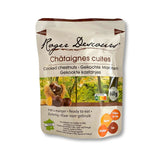
Ready cooked and peeled, there are sweet chestnuts, cooked and vacuum-packed. They can be used straight away and save the laborious peeling. As a snack for on the go there is the sweet chestnut snack.
In the kitchen
- Savoury: As a side dish with game, duck and goose, in red cabbage, in stuffings, soups and stews, with Brussels sprouts and mushrooms.
- Sweet: As a purée, as a cream, in cakes and desserts. A recipe can be found in the article Chestnut cream.
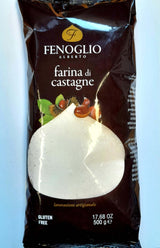
- As flour: Sweet chestnut flour tastes nutty and sweet and is suitable for pancakes, baked goods and for thickening soups. It contains no gluten and is therefore usually mixed with other flour, for example with spelt flour type 630.
The sweet chestnut in the monastic tradition
The sweet chestnut holds a special place in Hildegard von Bingen's Physica. She describes the tree in detail and praises the fruit like hardly any other food. In today's Hildegard von Bingen kitchen the sweet chestnut is therefore, together with spelt and fennel, one of the most important staple foods.
For context: the Physica is a 12th-century text and follows an understanding of nature that is not comparable to today's. It documents how the plant was used historically.
More on the Hildegard von Bingen kitchen as a whole can be found on the page Hildegard von Bingen nutrition.
Storage
- Fresh chestnuts do not keep for long. In the fridge, in a breathable bag, about one to two weeks.
- Freezing: Cooked and peeled, they freeze well.
- Chestnut flour should be stored cool, dry and well sealed and used up within a few months.
Frequently asked questions
Is a marron the same as a sweet chestnut?
Yes, botanically it is the same species. Marrons are particularly large varieties of sweet chestnut that are easy to peel.
How do you recognise an edible chestnut?
By the point with a small tuft of hair and by the husk with many fine, long spines. Horse chestnuts are round, smooth and have no point.
Can you eat horse chestnuts?
No. They are very bitter and can irritate the stomach and intestines.
Can you eat sweet chestnuts raw?
Raw, they are hard, astringent and hard to digest. The usual way is to roast or boil them.
When is chestnut season?
From late September to November.
Is chestnut flour gluten-free?
Sweet chestnuts naturally contain no gluten. Anyone who has to watch out for it should still check the labelling on the pack, because flours may be processed in the same mill.
More from the range
Sweet chestnuts, chestnut flour and sweet chestnut flour in honey can be found together with the spelt products in the category Eating with spelt. More recipes are collected on the page Hildegard von Bingen recipes.