


This page explains how to recognise mullein, how to harvest and dry its flowers, and where the plant got its many names.
What mullein is
The mulleins form the genus Verbascum in the figwort family. Several species grow in Central Europe. Three in particular are used for their flowers:
- Dense-flowered mullein (Verbascum densiflorum), with particularly large flowers
- Orange mullein (Verbascum phlomoides)
- Great mullein (Verbascum thapsus), the most common species
All three are biennial. In the first year the plant forms only a flat rosette of large leaves with a dense white felt. Only in the second year does it send up the tall stem with the flowers. After that it dies, leaving behind thousands of tiny seeds that remain viable in the soil for decades.
How to recognise it
- Growth habit: A single, upright stem as straight as a candle, often taller than a person, rarely branched.
- Leaves: Large, thick and soft as felt, grey-green to whitish green. They run down the stem.
- Flowers: Sulphur yellow, flat, with five petals, densely packed in a long spike. Some of the stamens have woolly hairs.
- Habitat: Sunny, dry, preferably on stony or sandy soils. Fallow land, railway embankments, rubble sites, woodland clearings.
- Flowering time: July to September.
Matching this article
Where the names come from
The German name "Königskerze" (king's candle) refers to an old custom: the dried stems were dipped in wax, resin or tallow and used as torches. This is also the origin of names such as "Himmelbrand" (heaven's fire) and "Fackelkraut" (torch herb).
"Wollblume" (wool flower) and "Wollkraut" (wool herb) refer to the felted leaves. These were once used as wicks and are said to have been placed in shoes to keep the feet warm.
Harvesting the flowers
Mullein does not open all its flowers at once. On each flower spike only a few open each day, spread over its whole length, and they drop off again the same day or the next. Anyone gathering flowers therefore has to harvest again and again over several weeks.
- When: In the late morning of a dry, sunny day, once the dew has dried.
- What: Only fully open flowers. They come away with a gentle tug.
- Where: In unpolluted locations, not right next to roads or railway tracks.
- How much: Only a few flowers per plant, so that seeds can form.
Drying
Mullein flowers are delicate. They contain mucilage, attract moisture quickly and then turn brown. Brown flowers can no longer be used.
- Dry quickly: Straight after harvesting, spread the flowers loosely in a single layer on paper or a rack.
- Warm and airy, but out of direct sunlight. A dehydrator at a low temperature works well.
- Ready is when they rustle and crumble when rubbed.
- Pack airtight immediately. Dried flowers quickly absorb moisture again.
General tips on methods and times can be found in the article Drying herbs.
Preparing an infusion
Mullein flowers are traditionally prepared as an infusion, often mixed with other herbs. One important point: the flowers carry fine hairs that can feel scratchy in the throat. So always pour the infusion through a paper filter or a fine cotton cloth; an ordinary tea strainer is not enough.
In flavour the flowers are mild, slightly sweet and honey-like.
Mullein in the monastic tradition
Mullein has been known as a medicinal plant since antiquity and was widespread in the monastery gardens of the Middle Ages. It is regarded as the plant that Hildegard von Bingen describes in the Physica under the name Wullena.
For context: the Physica is a 12th-century text and follows an understanding of nature that is not comparable to today's. It documents how the plant was used historically.
Mullein is often mentioned together with horehound and lungwort.
In the range
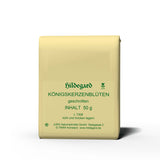
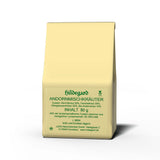
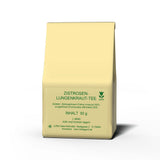
Dried flowers are available as mullein flowers, cut. Ready-made blends are the horehound herb blend and the cistus and lungwort tea. For preparation, the information on the respective label applies.
Frequently asked questions
When does mullein flower?
From July to September, in the second year after germination.
Which parts of mullein are used?
Mainly the yellow flowers. Less often the leaves as well.
Why do mullein flowers turn brown?
Because they attract moisture. They must be dried quickly and packed airtight immediately.
Why does mullein tea have to be filtered?
The flowers carry fine hairs that can feel scratchy in the throat. A paper filter or fine cloth holds them back.
Is mullein protected?
The common species are not specially protected. Even so, harvest only a few flowers per plant and leave the plant standing.
Is mullein biennial?
Yes. In the first year only the leaf rosette grows; in the second the plant flowers and then dies.
More from the range
More herbs can be found in the category Spices according to Hildegard von Bingen, and herbs for the cold season in the category Breathe freely. A sorted overview is given on the page The most important spices according to Hildegard von Bingen.