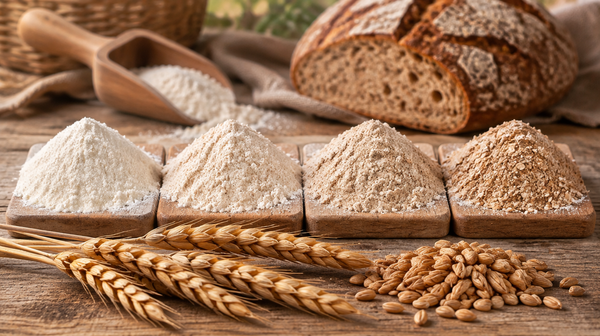

"Spelt is much better than wheat" – you hear that often. But is it really true? Does spelt contain less gluten? Is it differently composed? And what does Hildegard von Bingen have to do with it, having already described spelt in the 12th century as the "best of all grains"? In this article, you'll get the honest, scientifically sound answer – without nutritional myths, but with everything you really need to know.
Quick answers
What is the difference between spelt and wheat?
Botanically, spelt is a type of wheat, but an ancient hulled grain that has hardly been bred for yield. It tastes nuttier and contains no less gluten, but its gluten proteins are composed differently, which is why some people feel they tolerate it better. When baking, its dough is more delicate and dries out faster. For people with coeliac disease, spelt is just as unsuitable as wheat.
What is the difference between spelt flour and wheat flour?
The nutritional values are similar: spelt flour has a little more protein and gluten, whole wheat flour a little more fibre. Spelt flour absorbs less water, so the dough should be kneaded for a shorter time and can rest a little longer. What matters more than spelt or wheat is whether the flour is wholegrain or refined.
What are the benefits of spelt over wheat?
Its benefits are the more aromatic, nutty flavour, the original variety with its protective husk and, for some people, better perceived tolerance (not in coeliac disease). Spelt is not automatically healthier: a white spelt product is nutritionally worse than whole wheat.
What is the difference between spelt bread and wheat bread?
Spelt bread tastes nuttier and dries out faster because spelt dough holds less water. Wheat bread is usually fluffier and stays fresh longer. Whether a bread is more nutritious depends mainly on its wholegrain content, not on the type of grain.
What Does Science Say? Current State of Research at a Glance
– Prof. Dr. Friedrich Longin, State Plant Breeding Institute at the University of Hohenheim, from the most comprehensive proteome study on wheat species to date (Hohenheim/Mainz, 2,896 proteins analyzed from 150 flour samples), quoted from agrarheute.com.
The Wissensforum Backwaren e.V. summarizes the state of research: spelt and wheat are more similar in their classic nutritional composition than they are different. However, there are variety-specific differences that explain why many people subjectively tolerate spelt better.
The scientific conclusion is therefore more nuanced than a simple yes or no – and that's precisely what makes this comparison so interesting.
Matching this article
Spelt and Wheat: First, Let's Get Clear on What We're Talking About
Before we can compare, we need botanical clarity: Spelt is not the opposite of wheat. Spelt (Triticum aestivum subsp. spelta) belongs to the same plant genus as modern bread wheat (common wheat, Triticum aestivum). Both are types of wheat. Since 2017, the EU Commission has even recommended labeling spelt on ingredient lists as "wheat (spelt)" – because botanically speaking, it is wheat.
The key difference lies elsewhere: spelt is an ancient grain that has barely changed over thousands of years. Modern common wheat, on the other hand, has been optimized through intensive breeding for high yields, easy processability, and stable gluten content. Spelt has retained its original husk (the so-called hulled grain characteristic) – and that is precisely what accounts for part of its character.
Hildegard von Bingen prioritized spelt not because of marketing promises, but based on her own observation. Her achievement was the early intuition that how a grain is cultivated and processed is at least as important as what it contains.
Nutritional Comparison Spelt vs. Wheat: The Table
All figures refer to 100 g of whole grain flour (unprocessed grain, husked). Refined flours (e.g., Type 405 or Type 630) have significantly worse nutritional values – more on that below.
| Nutrient | Spelt Whole Grain Flour | Wheat Whole Grain Flour | Winner |
|---|---|---|---|
| Calories (kcal) | ~340 | ~325 | Wheat (marginally) |
| Protein (g) | 14–15 g | ~10–12 g | Spelt |
| Carbohydrates (g) | ~57–62 g | ~60–65 g | Similar |
| Dietary fiber (g) | ~8–9 g | ~10–12 g | Wheat (whole grain) |
| Iron (mg) | 4.2 mg | 3.3 mg | Spelt |
| Magnesium (mg) | ~130 mg | ~97 mg | Spelt |
| Zinc (mg) | ~3.5 mg | ~2.9 mg | Spelt |
| Selenium (µg) | higher | lower | Spelt |
| Gluten (g) | ~9.5–10.3 g | ~8.3–9.8 g | Wheat (less) |
| Vitamin E | higher | similar | Spelt |
| B vitamins (B1, B2, B6) | good | similar (more B3) | Similar |
| Tryptophan (amino acid) | all 8 essential | complete | Similar |
What the table shows: Spelt scores clearly in protein, iron, magnesium, and zinc. Whole grain wheat leads in dietary fiber – because spelt loses part of its fiber-rich bran during dehusking. Calorically, both are nearly identical.
The Gluten Question: Is Spelt Suitable for People with Gluten Intolerance?
This is the most widespread misconception surrounding spelt – and it is medically important to clarify:
Spelt is NOT gluten-free. Spelt actually contains slightly more gluten than ordinary common wheat. Spelt flour Type 630 contains 10.3 g of gluten per 100 g, while wheat flour Type 405 contains only 9.8 g. Anyone suffering from celiac disease must avoid spelt just as consistently as wheat (absolutely off-limits).
Nevertheless, many people report tolerating spelt better than wheat. And this subjective experience has a scientifically plausible background – even if it has not yet been conclusively demonstrated in controlled human studies:
| Gluten Type / Protein | Common Wheat | Spelt | Significance |
|---|---|---|---|
| Omega-5-gliadin | Yes – present | No – usually absent | Omega-5-gliadin is considered the main trigger of immediate-type wheat allergy (WDEIA) |
| Total gliadin content | lower | higher | Spelt has more gliadins, but a different composition |
| Glutenin content | higher | lower | Different gluten structure – partly explains different baking properties |
| ATIs | similarly high | similarly high | ATIs are discussed in research as a possible factor |
To put it simply: spelt does not contain less gluten, but different gluten proteins. The absence of omega-5-gliadin is a plausible reason why people with wheat intolerance (not celiac disease, but NCWS – non-celiac wheat sensitivity) sometimes tolerate spelt better. For those with actual celiac disease: no spelt.
Those who want to bake gluten-free will also find alternatives from us – including chestnuts, which also play a role in Hildegard's teachings.
Hildegard von Bingen on Spelt: The "Best of All Grains"
Hildegard von Bingen was not a nutritional scientist in the modern sense – but an observer of extraordinary precision. In her Physica (written around 1150–1160), she devotes one of the most enthusiastic descriptions among all foods to spelt:
"Spelt is the best grain, rich, strong, and more easily digestible than all other grains. It creates good blood and spreads joy in people and gives the flesh its delight. However it is prepared – as bread or as other food – it is pleasant and good for people."
– Hildegard von Bingen, Physica, Lib. I, Cap. LXIII (De Spelta)
This description sounds enthusiastic – and it is. What Hildegard expresses here in her typical 12th-century language can be contextualized from today's perspective as follows:
| Hildegard's Term | Possible Modern Interpretation |
|---|---|
| "rich, strong" | High protein content, valuable amino acids |
| "more easily digestible" | Different protein composition (no omega-5-gliadin) |
| "creates good blood" | Higher iron content (4.2 mg vs. 3.3 mg) |
| "spreads joy" | Contains tryptophan (amino acid) |
| "pleasant and good" | Digestibility, aromatic flavor |
Hildegard recommended spelt as the primary grain throughout her entire teachings – for all life situations. Her nutritional concept in particular is based on spelt as its centerpiece: Habermus (spelt porridge) for breakfast, spelt soup during fasting, spelt crackers as a snack. More on this in our article on Hildegard's kitchen.
Hildegard's preference for spelt is evident in the fact that she explicitly described it as superior – a statement she made this clearly for virtually no other food.
The Actually Decisive Difference: Whole Grain vs. Refined Flour
Here lies the greatest misunderstanding in the spelt-wheat comparison: The question "spelt or wheat?" is less important than the question "whole grain or refined flour?"
A spelt bread made from Type-630 spelt flour is nutritionally worse than a whole grain bread made from wheat. And a whole grain spelt bread is better than a white bread made from wheat. The degree of processing determines nutritional value more than the type of grain.
| Flour Type | What's in it? | Nutritional Value |
|---|---|---|
| Spelt whole grain flour (Type 1050+) | Whole grain: bran, germ, endosperm | Very good – all nutrients preserved |
| Spelt flour Type 630 | Endosperm only, bran & germ removed | Significantly fewer nutrients |
| Wheat whole grain flour | Whole grain | Very good – more dietary fiber than spelt whole grain |
| Wheat flour Type 405 | Endosperm only | Few nutrients |
Hildegard von Bingen intuitively anticipated this principle: she always recommended spelt as a whole grain or coarsely ground – never as fine, degerminated refined flour. The grain should be as natural as possible.
A Real Advantage of Spelt: Cultivation and Contaminant Levels
Here spelt has a clear, scientifically undisputed advantage over modern common wheat:
The husk of spelt protects the grain. This firm outer hull shields the grain from contaminants, pesticides, and fungal infestation. Studies show that spelt has lower pesticide residues than conventional common wheat. So if you buy organically grown spelt, you get a grain that is naturally better protected.
In addition: spelt manages without artificial fertilizers. It roots deeper, draws more trace elements from the soil (which explains its higher mineral content), and requires no chemical growth regulators. This makes it the more ecologically sensible grain.
For Hildegard's teachings, this is no coincidence: foods that grow in harmony with nature have, in her conviction, a higher life force – an intuition that is reflected in the sustainability argument for spelt.
Spelt or Wheat? A Decision Guide
| Situation | Recommendation | Rationale |
|---|---|---|
| People without complaints | Both as whole grain – spelt preferred | More protein, iron, magnesium; more aromatic; ecologically more sustainable |
| Celiac disease | Neither spelt nor wheat | Spelt contains more gluten than wheat – absolutely no substitute |
| NCWS (non-celiac wheat sensitivity) | Try spelt experimentally | Absent omega-5-gliadin – some people tolerate it significantly better |
| Wheat allergy (immediate type) | No spelt | Allergenic proteins are very similar; not a safe substitute |
| High protein needs | Spelt | Significantly more protein (14–15 g instead of 10–12 g/100 g) |
| Calorie reduction | No difference | Caloric content practically identical; whole grain of both varieties is more filling |
| Diet according to Hildegard / fasting | Spelt – explicitly | Hildegard's clear tradition; Habermus, spelt soup as core elements |
| Children & sensitive individuals | Spelt (whole grain, traditionally processed) | Different protein structure; long sourdough fermentation can improve digestibility |
The Decisive Tip: How to Process Spelt Correctly
Hildegard von Bingen knew that not only the ingredient matters, but also the preparation.
Sourdough beats yeast. A long sourdough fermentation with spelt flour can improve the bioavailability of minerals – because phytic acid (the natural inhibitory acid that binds minerals) is broken down during the fermentation process.
Soaking activates. Hildegard's Habermus recipe (letting spelt flakes soak in hot water) follows the same principle. Soaking activates enzymes.
Mill gently. Freshly milled spelt whole grain flour from a mill or a good organic store is superior to industrially processed spelt flour from the supermarket – because the germ with its valuable fatty acids and vitamins is preserved.
Our spelt products consistently follow these principles: whole grain, gently processed, according to Hildegard's tradition.
The 5 Biggest Spelt Myths – Debunked
Myth 1: "Spelt doesn't make you fat, but wheat does."
False. Both have nearly identical caloric density (~325–340 kcal/100 g). Those who want to lose weight don't need to switch grain types, but should pay attention to whole grain and portion sizes.
Myth 2: "Spelt is gluten-free."
False and medically dangerous for people with celiac disease. Spelt contains more gluten than common wheat (10.3 g vs. 9.8 g per 100 g of flour).
Myth 3: "Modern wheat contains much more gluten than it used to."
Partially false. According to Wissensforum Backwaren, modern wheat varieties contain more starch through breeding, but not more gluten than old varieties.
Myth 4: "Spelt bread is automatically better than wheat bread."
Only if it is made from whole grain. A light spelt bread made from Type-630 flour is nutritionally inferior to a genuine whole grain wheat bread. The degree of processing decides, not the type of grain.
Myth 5: "Those who can't tolerate wheat can always tolerate spelt."
Not automatically. With celiac disease: definitely not. With NCWS: possibly, due to the absence of omega-5-gliadin. With classic wheat allergy: exercise great caution. Always test individually and, when in doubt, have an allergological assessment done.
So: Is Spelt Better Than Wheat? The Direct Answer
In many respects yes – but with clear limitations.
Spelt (as whole grain) contains more protein, more iron, more magnesium, and more zinc than whole grain wheat. It is more sustainably cultivated, naturally better protected against contaminants, and its different protein composition explains why many people tolerate it better. For nutrition according to Hildegard, it is clearly the central grain.
At the same time: whole grain wheat has more dietary fiber. Spelt contains more, not less, gluten. And a light spelt product is worse than a whole grain wheat product. The question "spelt or wheat?" is less important than the question "whole grain or refined flour?"
Hildegard von Bingen has long given the answer in her own way – by recommending spelt not as a diet aid, but as the foundation of a mindful diet. Entirely in the spirit of her fundamental principle of discretio: the right measure, the right quality, the conscious choice.